Volcano Live
volcanolive.com
Ambrym Volcano | Dr John Seach
Last updated: January 2026

Ambrym Island, Malampa Province, Vanuatu
16.25 S, 168.12 E
summit elevation 1334 m
Pyroclastic shield volcano with 12 km caldera
Ambrym volcano is one of Vanuatu's most active volcanoes. It features a massive 12-km-wide summit caldera with an ash plain and multiple craters (mainly Benbow and Marum). Persistent lava lakes were present in Benbow and Mbwelesu craters for many years until they drained during a major intra-caldera flank eruption in December 2018. No lava lakes have reformed since. Activity includes gas emissions, seismic unrest, occasional ash plumes, and minor eruptions.
Geology and Volcanology
Ambrym is a large basaltic shield volcano in the New Hebrides volcanic arc. The 12-km-wide caldera formed around 50 AD during a major Plinian eruption (VEI 6) that produced dacitic pyroclastic flows, initially followed by basaltic material. A thick pyroclastic sequence overlies pre-caldera lava flows. Post-caldera activity built cones like Benbow and Marum, with frequent intra-caldera eruptions, lava lakes, and occasional flank fissures. The volcano shows high degassing rates and rift-zone intrusions influenced by regional tectonics. The caldera floor is a desert-like ash plain contrasting with the island's thick jungle.
Warning: Approaching or descending into Ambrym's craters is extremely dangerous due to risk of sudden explosions, rockfalls, toxic gas emissions (SO₂, CO₂), and unstable terrain. Lava lakes, when present, pose additional hazards from spattering and overflows. Access is often restricted; professional guides and gas masks required. Visitors enter at their own risk.
Current Activity (January 2026)
Ambrym remains at Volcanic Alert Level 2 (major unrest). On 8 January 2026, a minor ash plume was detected in satellite imagery rising from the caldera. Ongoing seismic activity includes volcanic tremor and volcano-seismic events. Fumarolic plumes continue from Benbow and Marum craters. No lava lakes are present, and activity is confined to the caldera. VMGD advises staying outside the Permanent Danger Zone (1 km around Benbow, 2 km around Marum, and 500 m from 2018 ground cracks). No immediate threat to populated areas.
Ambrym volcano photos by Dr John Seach
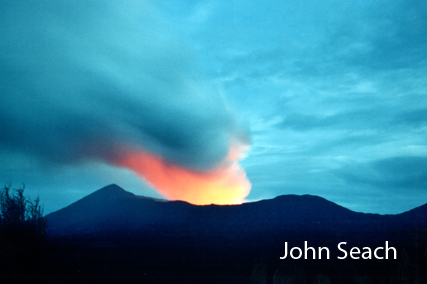
Benbow crater glow, Ambrym Island, Vanuatu 2007.
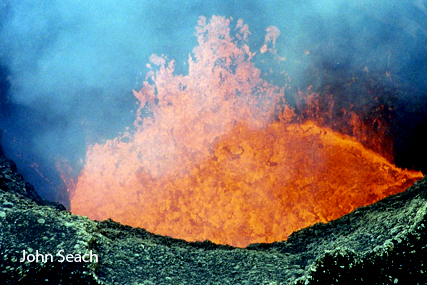
Ambrym volcano lava lake 2002.
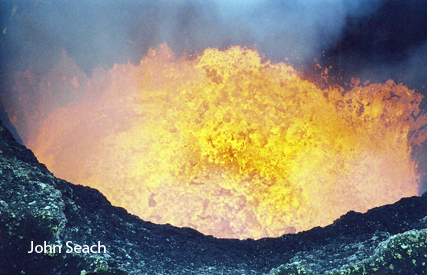
Mbwelesu lava lake, Ambrym volcano.
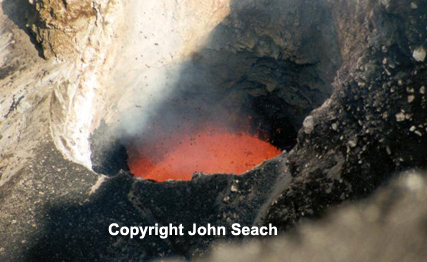
Ambrym volcano lava lake 1999 - Dr John Seach.
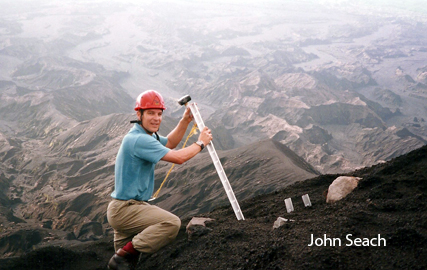
Dr John Seach preparing to abseil into Benbow crater in 1999.
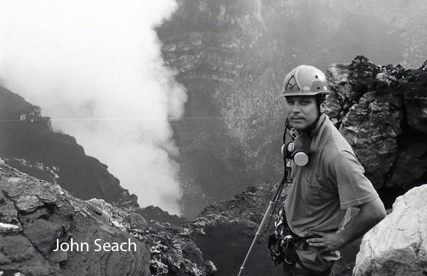
Dr John Seach inside Benbow lava lake crater in 1999.
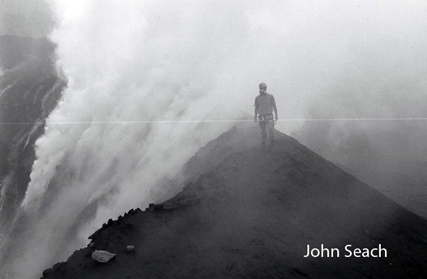
Dr John Seach inside Benbow lava lake crater in 1999.
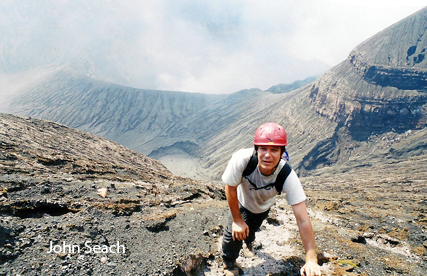
Dr John Seach free-climbing out of Benbow lava lake crater 2002.
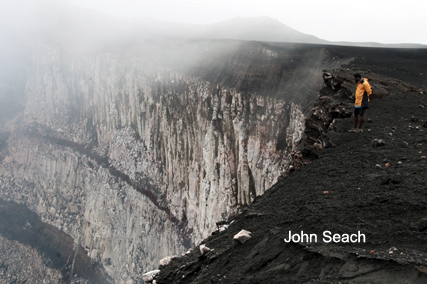
Mbwelesu crater, Ambrym Island, Vanuatu.
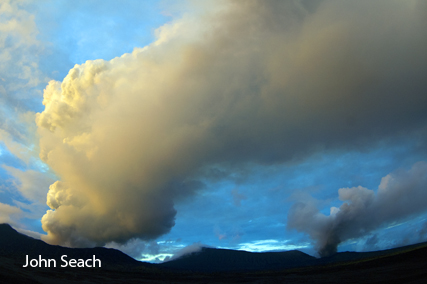
Ash and steam emission from Benbow crater, Ambrym Island 2007.
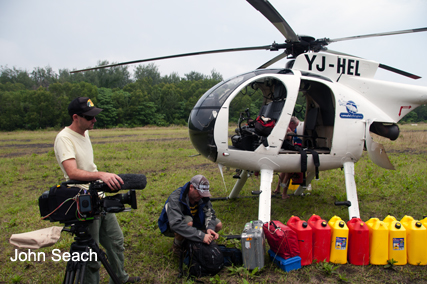
Ambrym filming expedition 2010.
The 100 sq km summit caldera contrasts sharply with the island's thick jungle. Specialized plants and animals thrive in the acidic environment.
John has led expeditions to the craters more than 180 times since 1998.
Ambrym lava lake video by Dr John Seach (2009)
Ambrym Eruption Reports
Further reading
Shreve, T., Grandin, R. and Boichu, M., 2022. Reservoir depressurization driven by passive gas emissions at Ambrym volcano. Earth and Planetary Science Letters, 584, p.117512.
Moussallam, Y., et al., 2021. How to turn off a lava lake? A petrological investigation of the 2018 intra-caldera and submarine eruptions of Ambrym volcano. Bulletin of Volcanology, 83(5), pp.1-19.
Nemeth, K. and Cronin, S.J., 2011. Drivers of explosivity and elevated hazard in basaltic fissure eruptions: the 1913 eruption of Ambrym Volcano, Vanuatu (SW-Pacific). Journal of Volcanology and Geothermal Research, 201(1-4), pp.194-209.
Robin, C., Eissen, J.P. and Monzier, M., 1993. Giant tuff cone and 12-km-wide associated caldera at Ambrym Volcano (Vanuatu, New Hebrides Arc). Journal of Volcanology and Geothermal Research, 55(3-4), pp.225-238.
Ambrym Volcano Eruptions
2026, 2024, 2022, 1996-2018, 1994, 1991, 1990, 1989, 1988, 1986, 1984-86, 1983, 1981, 1980, 1979, 1977, 1973-76, 1972, 1971, 1967-70, 1964-66, 1963, 1961-63, 1960, 1959, 1958, 1957, 1955, 1954, 1953, 1952, 1950-51, 1942, 1938, 1937, 1935-36, 1929, 1915, 1913-14, 1912, 1910, ?1909, 1908, 1898, 1894-95, 1888, 1886, 1884, 1883, 1871, ?1870, 1863-64, 1820?, 1774, 50 AD.