Volcano Live
volcanolive.com
Usu Volcano | Dr John Seach
Last updated: January 2026

Hokkaido, Japan
42.54 N, 140.84 E
summit elevation 731 m
Stratovolcano (within Toya caldera)
Usu is a prominent stratovolcano on Hokkaido, part of the Toya caldera system. Famous for repeated phreatomagmatic eruptions and dome growth (including Showa-Shinzan in 1943-45), it overlooks Lake Toya and is close to populated areas. Photos on this page are from the 2000 eruption.
Warning: Sudden phreatic/phreatomagmatic explosions and dome collapses can produce ash plumes, ballistic projectiles, and pyroclastic flows. Exclusion zones enforced during unrest; summit access hazardous.
Geology and Volcanology
Usu is an andesitic-dacitic stratovolcano with multiple summit domes (O-Usu, Ko-Usu, Showa-Shinzan) in the southern part of Toya caldera. Eruptions are typically phreatomagmatic due to groundwater interaction, producing explosive ash and dome extrusion. Part of the Northeast Japan Arc subduction zone. Monitored intensively by JMA with seismicity, deformation, gas, and thermal data.
Current Activity (January 2026)
Usu remains quiet with no eruptive activity since 2000-2001. Low seismicity and stable deformation. Minor fumarolic emissions from Showa-Shinzan and craters. Alert level normal. Monitoring by JMA ongoing; capable of sudden reactivation.
Usu volcano photos by Dr John Seach (2000 eruption)
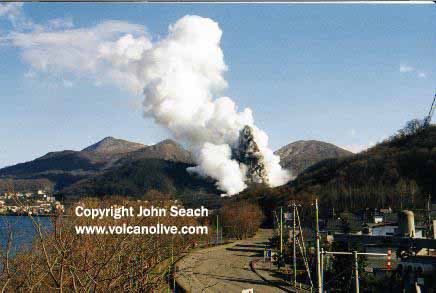
Mt Usu Eruption, April 2000. This photo was taken from inside the evacuated town of Toyako Onsen by Dr John Seach.
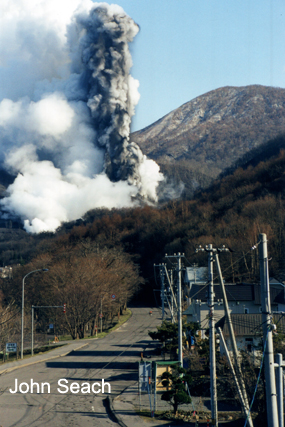
Usu volcano eruption 2000
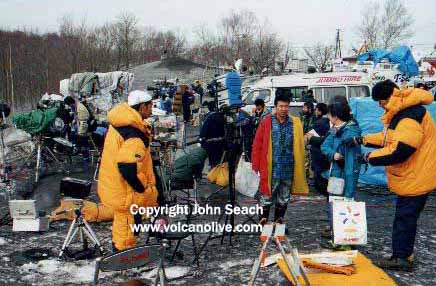
Media coverage of Usu eruption 2000
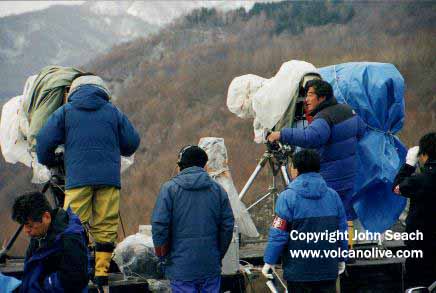
Media keeping watch on Usu volcano in 2000
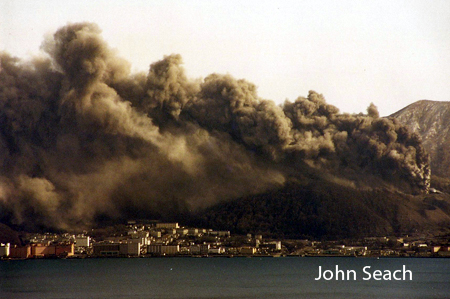
Usu eruption and Toyako Onsen in 2000

Usu volcano eruption 2000
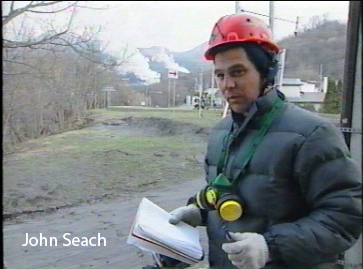
Dr John Seach at Usu eruption 2000. Active vents in background.
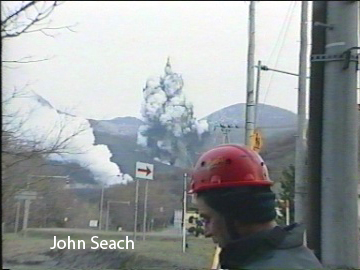
Usu volcano eruption, Japan 2000
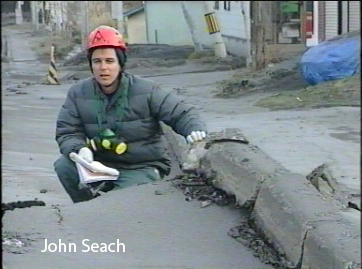
Volcanic earthquake damage, Usu volcano, Japan 2000
Post-2001 Quiescence (ongoing)
Return to low-level fumarolic activity after 2000-2001 eruption.
2000-2001 Eruption
Phreatomagmatic explosions from new craters (West-Nishiyama and Kompira) with significant uplift (~80 m). Evacuation of 13,000 residents; first activity in 22 years.
The 2000 eruption of Mt Usu volcano began after several days of increased seismicity and ground deformation. The first new crater opened in the West-Nishiyama area on 31st March 2000, followed by the activity in the Kompira area on 1st April. Eruptive activity lasted for several months, and gradually declined, with the new vents obtaining a fumarolic stage by mid 2001. A large area of Usu volcano deformed during the eruption. The greatest changes occurred near West-Nishiyama craters, with an upward displacement of 80 m. The eruptions were phreatic and phreato-magmatic.
1977-1982 Eruption
Cryptodome growth and explosions forming new summit crater.
1663 Large Eruption
Largest historical eruption on Hokkaido.
Further reading
Tomiya, A. and Takahashi, E., 2005. Evolution of the magma chamber beneath Usu Volcano since 1663. Journal of Petrology, 46(12), pp.2395-2426.
Jousset, P. et al., 2003. Elastic models for the magma intrusion associated with the 2000 eruption of Usu Volcano, Hokkaido, Japan. Journal of Volcanology and Geothermal Research, 125(1-2), pp.81-106.
Usu Volcano Eruptions
2000-2001, 1977-1982, 1944-1945, 1910, 1853, 1822, 1769, 1663, 1638, 1626, ?1611