Volcano Live
volcanolive.com
Dallol Volcano | Dr John Seach
Last updated: January 2026

Danakil Depression, northern Ethiopia
14.24 N, 40.30 E
summit elevation -48 m (lowest subaerial volcano on land)
Explosion craters / hydrothermal field
Dallol in the Danakil Depression of northern Ethiopia is one of the lowest points on Earth and the world's hottest inhabited location (annual mean ~34 C 1960-1966). Dallol is the lowest altitude subaerial volcano in the world, entirely below sea level. The area has a wild and impressive landscape visited by few people.
The Dallol hot springs are an important economic source of manganese, potash, and rock salt. The hot springs at Dallol were formed by explosive eruptions which formed maars.
The Dallol Geothermal Area is an important region for astrobiology studies as the environment hosts life forms at natural physical-chemical extremities. Fluids in the Dallol area are salty (>500 g/L) and acidic (pH ~0.5).
Warning: Extreme heat, highly acidic and saline pools, toxic gases (CO2, H2S, SO2), and unstable ground pose severe risks. Remote location with limited access/rescuability. Expeditions require expert guidance and preparation.
Geology and Volcanology
Dallol is a hydrothermal explosion crater field in the Danakil Depression, part of the Afar Triple Junction rift system. Formed by phreatic eruptions interacting with shallow salt deposits. Persistent high-temperature fumaroles and acid springs. No recent magmatic eruptions. Monitored remotely by Ethiopian authorities.
Current Activity (January 2026)
Dallol remains in an active hydrothermal phase. Vigorous fumaroles, hot acid springs, and salt crust formation continue. Low seismicity. Tourism expeditions ongoing with strict safety protocols. Monitoring by Ethiopian authorities.
Dallol volcano photos by Dr John Seach (March 2024 expedition)

Dallol volcano, Ethiopia. March 2024 expedition by John Seach

Dallol volcano, Ethiopia. March 2024 expedition by John Seach

Saltiest pool in the world (>400 g/L), on Lake Asale salt plain, Ethiopia.
March 2024 expedition by John Seach

Dallol volcano, Ethiopia. March 2024 expedition by John Seach

Lake Asale (Lake Karum), Ethiopia. March 2024 expedition by John Seach

Dallol volcano, Ethiopia. March 2024 expedition by John Seach

Dallol thermal springs, Ethiopia. March 2024 expedition by John Seach

Salt mountain, Dallol, Ethiopia. March 2024 expedition by John Seach

Salt trucks, Dallol, Ethiopia. March 2024 expedition by John Seach

Potash deposits, Dallol, Ethiopia.
These are possibly the world's youngest marine potash formations.
The thickness of the potash deposits are from 15-40 m.
March 2024 expedition by John Seach

Dallol thermal springs, Ethiopia. March 2024 expedition by John Seach

Dallol thermal springs, Ethiopia. March 2024 expedition by John Seach
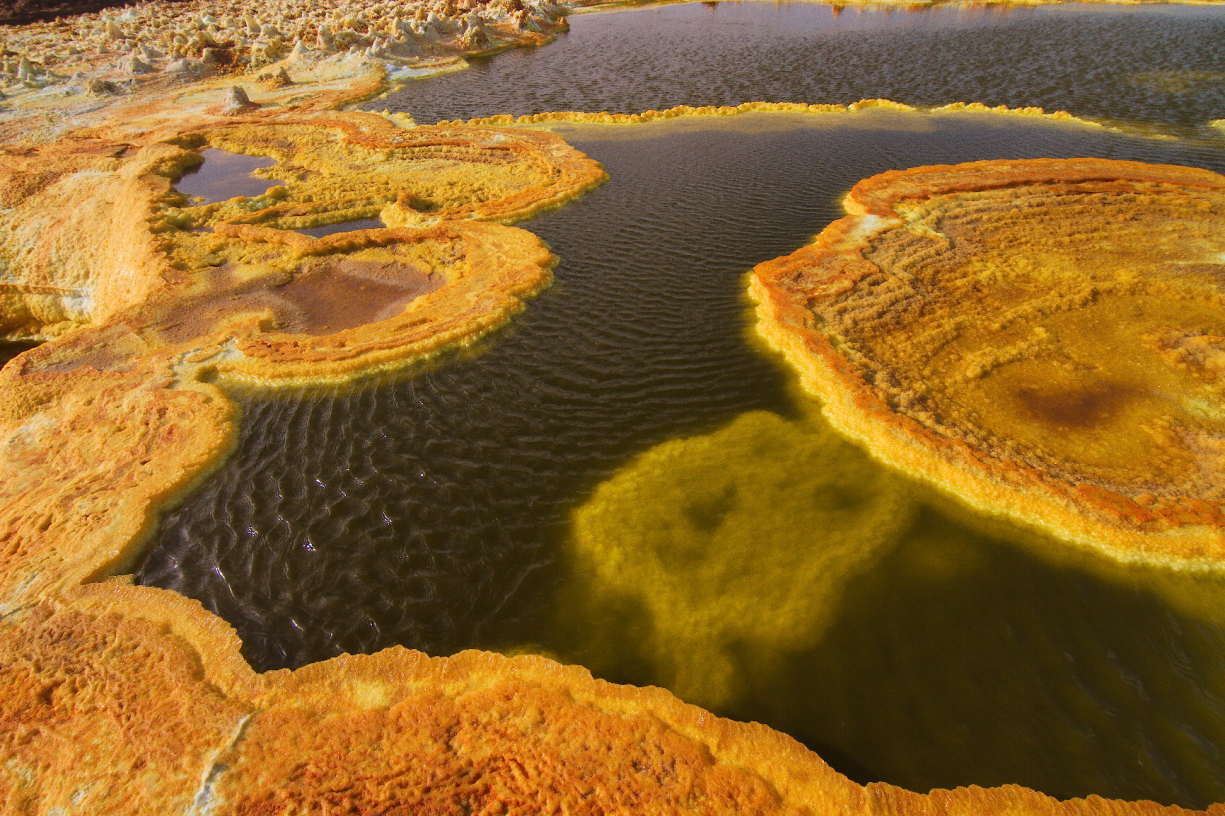
Dallol thermal springs, Ethiopia. March 2024 expedition by John Seach
Further reading
Lopez-Garcia, J.M. et al., 2020. Origin and evolution of the halo-volcanic complex of Dallol: proto-volcanism in Northern Afar (Ethiopia). Frontiers in Earth Science, 7, p.351.
Cavalazzi, B. et al., 2019. The Dallol geothermal area, Northern Afar (Ethiopia) - An exceptional planetary field analog on Earth. Astrobiology, 19(4), pp.553-578.
Darrah, T.H. et al., 2013. Gas chemistry of the Dallol region of the Danakil Depression in the Afar region of the northern-most East African Rift. Chemical Geology, 339, pp.16-29.
Edelmann, J. and Roscoe, R., 2010. Volcano tourism in Ethiopia and the Danakil rift zone. In Volcano and Geothermal Tourism (pp. 59-67). Routledge.
Dallol Volcano Eruptions
1926 (phreatic)